To bet on Bitcoin on Moon.com, select the BTC market, enter a wager, choose leverage, review the displayed position and liquidation level, select Up or Down, set optional exit controls and confirm only after checking fees and risk. The wager is on price movement; it does not purchase Bitcoin.
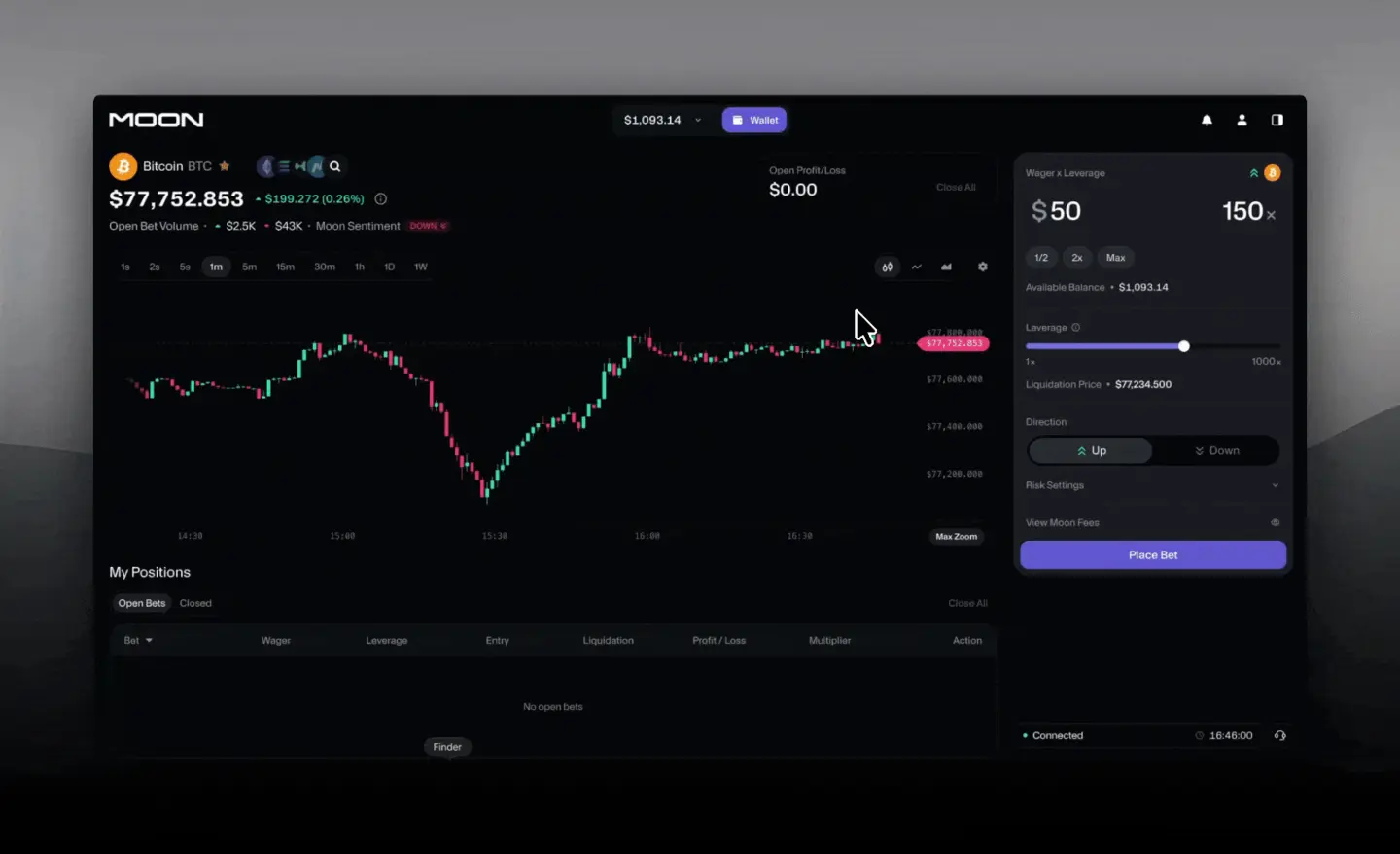
Step 1: open the BTC market
Use the market selector to locate Bitcoin and confirm that the displayed instrument is BTC. Review the current quote and the chart timeframe. A short timeframe can make normal volatility look unusually dramatic, while a long timeframe can hide the path that a leveraged position must survive.
Step 2: choose the wager
The wager is the amount allocated to that position. Start with the loss limit rather than the hoped-for profit. If losing the full wager would affect essential spending or encourage immediate loss chasing, the amount is too high.
Step 3: review leverage and Bust Price
Leverage multiplies exposure and moves liquidation closer. Compare several settings and watch the Bust Price change before selecting one. The displayed liquidation value is more useful than thinking only in terms of a multiplier.
Step 4: choose Up or Down
Up expresses the view that the reference price will rise; Down expresses the view that it will fall. Neither button predicts the market. Write down what would invalidate the view and where the position should be closed before entering.
Step 5: manage and close
Monitor the open position, the relevant exit levels and the effect of fees. Closing early can reduce either a profit or a loss. Avoid moving an exit merely because the market is approaching it. A planned small loss is usually easier to manage than an improvised large one.
Frequently asked questions
Can I withdraw Bitcoin from a BTC wager?
No. A directional BTC wager is not a purchase of Bitcoin and does not create an on-chain asset to withdraw.
What happens if BTC reaches the Bust Price?
The position is liquidated according to the platform rules and the wager can be lost.
Should I use the shortest chart timeframe?
Not automatically. Use a timeframe that helps you understand volatility and the liquidation distance; no timeframe guarantees a better result.